Can your kid sit up and hold their head steady for the whole ride? If you cannot answer that with an unequivocal "yes," then before we talk about tires, shocks, or trailers, we need to talk about basic developmental physiology. I’ve spent https://highstylife.com/can-i-use-a-child-bike-seat-on-an-e-bike-a-service-writers-guide-to-family-cycling/ nine years behind a service counter, and I have seen too many parents rush into trailer setups because they’ve seen a glossy advertisement. The "bouncing" you feel isn't always just a trailer issue—sometimes, it’s a symptom of a child who isn't ready for the vibration frequency of a bike trailer, or a setup that is fundamentally misaligned with the child's physical capabilities.
If you're looking for an answer like "just wait until they are ready," I’m going to stop you right there. That phrase is dangerous and unhelpful. When a child is "ready" isn't a nebulous milestone marked by a birthday; it is defined by specific, observable physical markers: the ability to hold the head upright without bobbing when encountering moderate vibrations, the ability to maintain a neutral spine while buckled into a five-point harness, and the neck strength to support the extra weight of a helmet without slouching.
The Physics of the "Bounce": Tire Pressure and Suspension
I keep a tiny, weathered notebook in my workbench drawer. Every time I hear a customer complain about a "rattling" or "bouncing" ride, I flip through it. The list of things that have rattled loose mid-ride is legendary: loose hitch pins, over-tightened axle nuts that snapped, and a plastic spacer on a high-end hitch that decided it wanted to become a permanent resident of a storm drain in 2017. Most "bouncing" sensations are actually poor energy dissipation.
Let's look at the mechanical side of things. If your trailer bike commute with baby essentials feels like it’s vibrating your child’s teeth out, you are likely running your tires at the maximum PSI printed on the sidewall. Do not do this.
Tire Pressure Optimization
Most trailer tires are rated for 30–40 PSI. If you weigh 150 lbs and your child weighs 30 lbs, running those tires at 40 PSI is like trying to ride on two rubber hockey pucks. You lose all natural damping. Pretty simple.. Drop the pressure by 5–8 PSI (staying within the safe range of the tire's ply rating) to allow the tire casing to absorb those micro-vibrations before they travel up the hitch arm.
Suspension Trailer Settings
If your trailer has adjustable suspension, stop leaving it in the "stiff" position just because you bought the expensive model. Most suspension trailers have a spring-tension setting based on the child's weight.
Child Weight Suspension Setting Common Mistake Under 25 lbs Soft/Plush Ignoring the knob entirely 25–40 lbs Mid-range Maxing it out for "stability" 40+ lbs Firm Not adjusting as they growDevelopmental Readiness: The Neck Control Metric
I'll be honest with you: i see it every spring: a parent rolls into the shop with a four-month-old in a trailer, wondering why the child looks uncomfortable. "But the seat reclines!" they say. Reclining doesn't replace musculoskeletal maturity.
If your child cannot sit up unassisted, their spine cannot handle the lateral and vertical G-forces of a bike ride. The bouncing you feel is amplified by the fact that your child’s head is essentially a pendulum. When the trailer bounces, their head snaps forward and back. This is exactly why we insist on:
- The Sit Test: Can they sit in a corner without support for 15 minutes? If no, they stay off the bike. The Head-Steady Check: If you walk briskly, does their head remain stable? If it wobbles, it will oscillate in a trailer.
If you are struggling with this, please, for the love of everything, do a test ride without the child. Load the trailer with a bag of sand or a weight equivalent to your child. Go for a ride on your usual route. If the trailer is still bouncing with a static weight, it’s a trailer problem. If it’s smooth with the sand but bouncy with the kid, you are dealing with a child who lacks the core stability to dampen the ride.
Helmet Fit: The Most Ignored Safety Feature
It absolutely grinds my gears when I see a child in a trailer wearing a helmet that is tilted back, exposing their forehead, with the chin strap hanging loose enough to fit a sandwich through. If your trailer is bouncing, a loose helmet becomes a projectile inside the cockpit. It hits their nose, it cuts into their chin, and it provides zero protection.
The "Two-Finger" Rules for Helmets
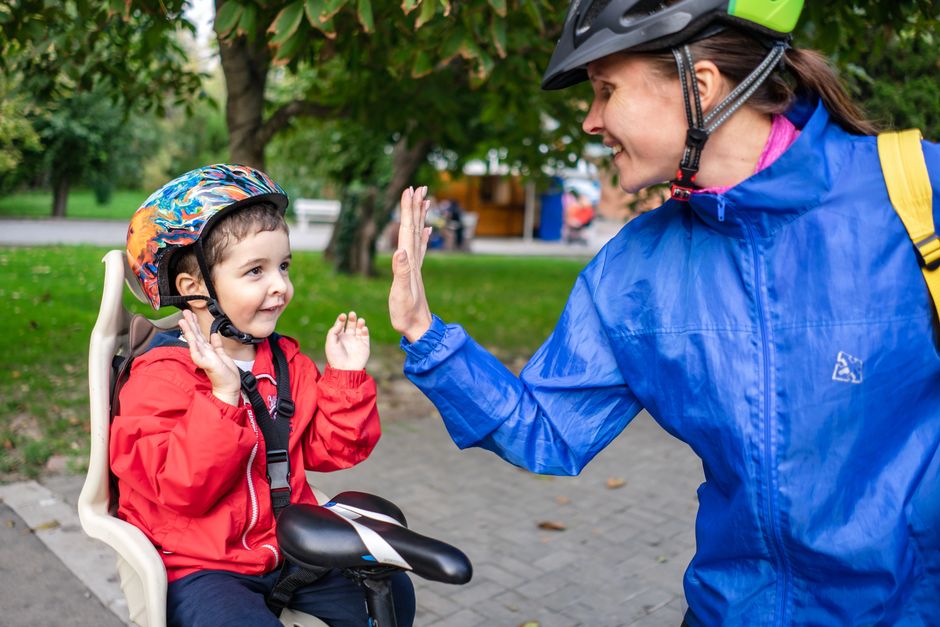
The Forehead Rule: The helmet should sit low, two fingers above the eyebrows. If it's tilted back, it's a glorified hat. The V-Strap Rule: The side straps should form a perfect "V" just under the ears. If they are messy, the helmet will rotate in a crash. The Chin Rule: Two fingers should fit between the chin and the strap. Not four. Not zero.When you have a bouncy trailer, a poorly fitted helmet will physically strike the back of the seat or the headrest every time you hit a bump. This causes the child to lean forward, which ruins their posture, which makes the bounce feel even worse.
Front Seat vs. Rear Seat vs. Trailer: What’s Best?
If you find that the trailer is simply too bouncy for your specific local roads, you might be looking at the wrong equipment. Each carries its own distinct vibration profile:
1. Front-Mounted Seats
These are best for "feel." Because the child is between your arms, your body acts as the ultimate suspension system. You know exactly what the road surface is doing, and you naturally move to avoid bumps. However, if your child is tall, they will inevitably block your pedaling (the "duck walk" knee hit). If you have to pedal bow-legged to clear the seat, you are losing your own balance, which makes the entire bike unstable.
2. Rear-Mounted Seats
These act like a long lever. Every bump the rear wheel hits is magnified by the time it reaches the seat. If you have a rear rack, ensure your rear rack compatibility is checked. A rack that isn't bolted down with blue Loctite will rattle, and that rattle will travel directly into the child's seat. I once had a client whose rack was loose, and the "bounce" they felt was actually the rack vibrating against the frame.
3. Bike Trailers
Trailers are the most "stable" for the rider, but the most disconnected for the child. The bounce here comes from the hitch. If your hitch has play—meaning there is a gap between the hitch pin and the receiver—you get a "clunk" every time you accelerate or brake. That "clunk" is the precursor to the "bounce."
Smooth Route Choice: The Final Defense
You can buy the most expensive, carbon-fiber, full-suspension, air-tire trailer on the market, but if you choose a route with potholes, jagged curbs, and gravel transitions, you will have a bouncy ride.
I call this "The Path of Least Resistance." When I’m riding with my kids, I am hyper-focused on the road surface. I look 20 feet ahead, not at the ground right in front of my tire. If the bike lane has a seam, I take the lane. If the path has tree roots, I slow down to a crawl. Smooth route choice is the most effective "suspension" you have.
Remember: You are the captain of this ship. Your child is a passenger who cannot control the ride. Every time you skip a helmet check, ignore a loose bolt, or ride too fast over a root, you are asking your child to compensate for your shortcuts. Take five minutes before you leave to check the pressure, tighten the straps, and verify the fit. Your kid’s comfort—and safety—depends on it.
Now, go out, do your test ride with a weighted trailer, and report back to me. Did the bouncing stop, or is your hitch mount loose? I suspect it's the latter.